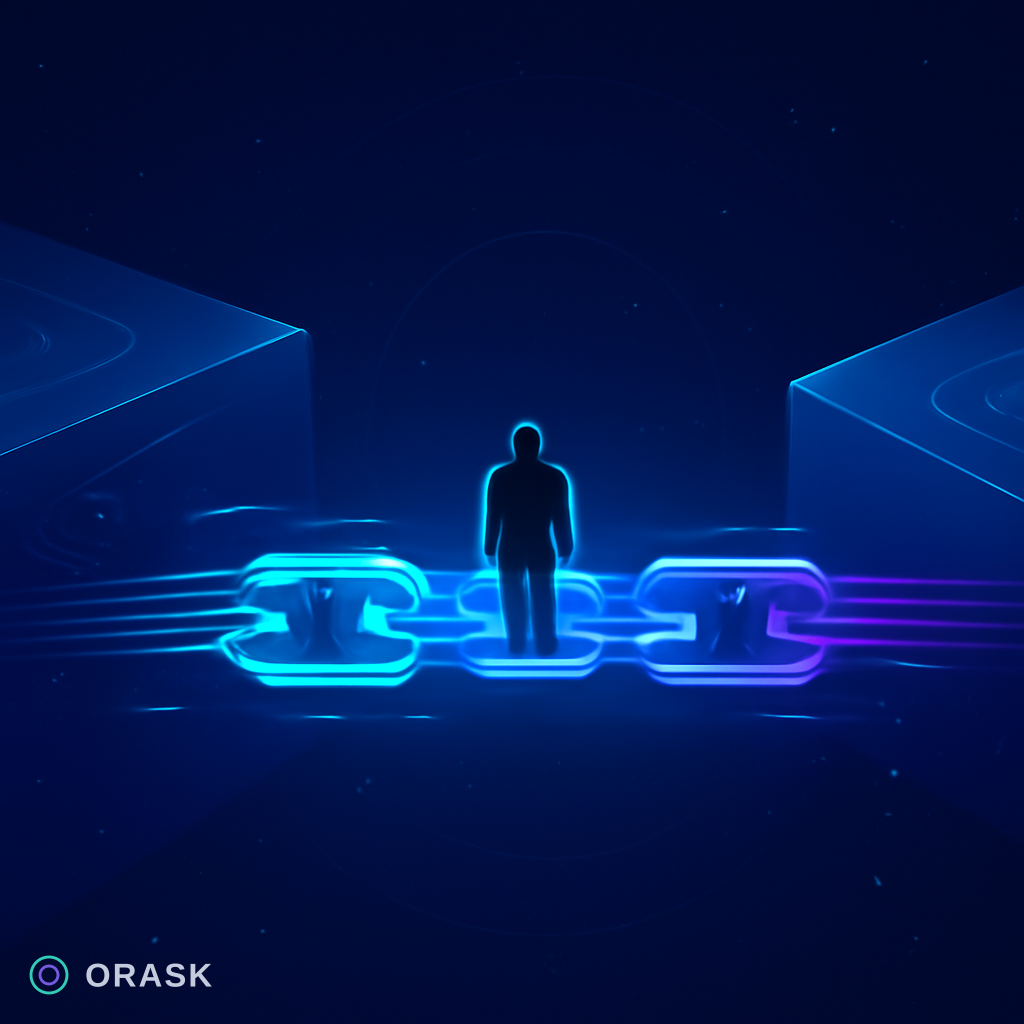
If you have spent any time in crypto, you have probably noticed that blockchains do not talk to each other naturally. Bitcoin lives on its own network. Ethereum lives on its own. Solana is separate again. Each is a kind of walled garden, and assets native to one chain cannot simply be sent to another the way you might forward an email.
That isolation is a real practical problem. A user who holds ETH but wants to use a lending protocol on a different chain is stuck — unless there is something in between. That something is a bridge.
**What a Bridge Actually Does**
A cross-chain bridge is a piece of software infrastructure that lets users move tokens (or, in some designs, data) from one blockchain to another. The mechanics vary, but the most common model works like this: you deposit your original token into a smart contract on the source chain, where it is locked up. On the destination chain, a corresponding "wrapped" version of that token is minted — a new token that represents a claim on the locked original. When you want to go back, you burn the wrapped token and the original is released.
Think of it like a coat check. You hand over your coat (your token), get a ticket (the wrapped token), and trust that when you return the ticket, you get your coat back. The system only works if the coat check is trustworthy and the ticket cannot be forged.
Other bridge designs use liquidity pools instead of lock-and-mint. In this model, a pool of funds sits on both chains. You deposit on one side, and a liquidity provider pays you out on the other. This avoids minting new tokens but depends on there always being enough liquidity available.
**The Role of Validators and Oracles**
The trickiest part of any bridge is the communication layer between chains. One blockchain cannot natively read the state of another, so bridges need some mechanism to verify that a deposit really happened before releasing funds on the other side.
Some bridges use a set of trusted validators — a small group of entities who confirm cross-chain events. Others rely on oracles, which are services that feed external data (like confirmation of a transaction) into a smart contract. More sophisticated designs use cryptographic proofs, such as zero-knowledge proofs, that allow one chain to mathematically verify something happened on another chain without trusting a third party at all. These "trustless" or "trust-minimized" designs are generally considered more secure but are much harder to build.
**Why Bridges Are a Major Target for Hackers**
Bridges are consistently among the most attacked infrastructure in crypto, and the losses have been enormous across the industry. The reason is straightforward: bridges hold large amounts of locked tokens in one place. That concentration of value makes them attractive targets.
The attack surface is wide. Smart contract bugs can let an attacker forge a withdrawal message and drain the locked funds. Validator systems have been compromised when attackers gained control of enough signing keys to authorize fraudulent transactions. Even the logic connecting the two chain-specific contracts can contain flaws that allow minting tokens without making a real deposit.
Several high-profile exploits have illustrated just how costly these vulnerabilities can be. In each case, the result is that users who held wrapped tokens suddenly found their claims backed by nothing — the underlying assets had been stolen.
**Wrapped Tokens and Counterparty Risk**
Even when a bridge is not actively hacked, users take on what is called counterparty risk. A wrapped token is only as good as the bridge that issued it. If the bridge shuts down, gets hacked, or has its contracts frozen, the wrapped token may become worthless or unredeemable.
This is meaningfully different from holding a native asset. When you hold ETH, you depend on the Ethereum network itself. When you hold a wrapped version of ETH on another chain via a bridge, you depend on the Ethereum network and the bridge operator and the smart contracts on both ends. Each layer adds a new point of potential failure.
**Newer Approaches Trying to Reduce Risk**
The industry has been working on safer designs. Zero-knowledge proof-based bridges aim to eliminate trusted intermediaries entirely, letting mathematical proofs do the verification. Some Layer 2 networks, like rollups built on Ethereum, have native bridges that inherit Ethereum's own security model rather than introducing a new one.
There is also growing interest in cross-chain messaging standards that allow applications, not just tokens, to communicate across chains — potentially enabling more flexible and audited infrastructure than older bridge designs.
**What to Keep in Mind as a User**
If you use a bridge, a few practical points are worth understanding. Not all bridges are equal in their security model — some are highly centralized and depend on a small number of trusted operators, while others are more decentralized. Older bridges with large volumes and long audit histories have a somewhat longer track record to evaluate, though past security is not a guarantee of future safety.
The wrapped token you receive is a distinct asset from the original. Understand what backs it and how redemption works before committing significant funds.
Cross-chain infrastructure is one of the more technically complex areas of crypto, and the gap between how bridges are marketed and how they actually work under the hood is often significant. Knowing the basics — that you are trusting a locking mechanism, a communication layer, and a minting contract all at once — is a reasonable starting point for anyone using them.